
The method, examined
How to manifest
The instructions are usually written as though wanting is the hard part. It is not.
See pricing and trial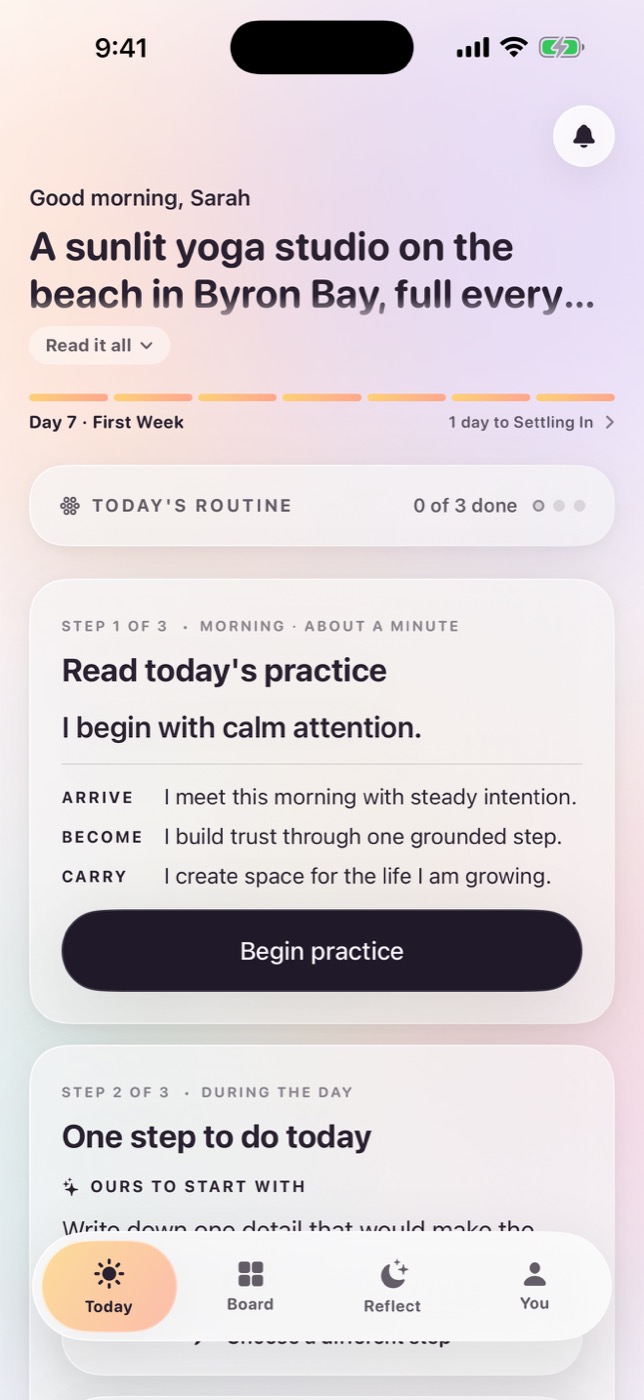
The short answer
Manifesting works when it makes a goal specific, keeps it in view daily, pairs it with a concrete situation where you will act, and produces a record of what you actually did. It does not work as a way of causing events by thought. Every technique that produces something is doing some combination of those four things, and the ones that produce nothing have removed the fourth.
What the word means now, which is not what it meant
Manifesting arrived in its current form through New Thought writing in the late nineteenth century, passed through mid-century positive thinking, and reached most people alive today through a 2006 film and the book that followed it. In that lineage the claim is literal. Thought is a force, like gravity, and holding the right thought attracts the matching outcome. That is the version the word still carries for a lot of people, and it is the version this guide does not defend.
What the word usually describes in practice is something else entirely. Ask someone who says manifesting changed their year what they actually did and the answer is rarely that they sat still and thought hard. They wrote something down repeatedly. They looked at it every morning. They noticed opportunities they would previously have walked past. They said yes to something. The practice around the belief did the work, and it would have done the same work under a different name.
That gap matters because it decides what advice is useful. If thought causes outcomes, the correct instruction is to believe harder and remove doubt. If a daily practice causes outcomes, the correct instruction is to make the practice small enough to survive a bad week. Those two pieces of advice point in opposite directions, and only one of them has anything behind it.
The four things doing the work
Strip the vocabulary off every popular technique and roughly four mechanisms remain. Knowing which one you are using tells you what to expect from it and where it will fail.
Specificity
A goal you can picture in enough detail to recognise when it arrives behaves differently from a wish. Locke and Latham spent three decades establishing that specific and demanding goals produce higher performance than vague encouragement to do your best, across hundreds of studies and most kinds of task. Most manifestation techniques force specificity as a side effect, because you cannot write a sentence three times a day without deciding what the sentence says.
Salience
A goal you see every morning competes for attention against everything else in your life, and repetition is how it stays in the running. This is the mechanism behind vision boards, the 369 method, affirmations and daily scripting alike. It is real and it is modest. Salience decides what you notice. It does not decide what exists to be noticed.
Implementation intentions
This is the strongest of the four and the one almost no manifestation guide mentions. Gollwitzer and Sheeran reviewed the effect across ninety-four independent tests and found that pairing a goal with a specific situation, in the form of when this happens I will do that, produced a medium to large improvement in whether people followed through. Not thinking about the goal more. Deciding in advance where and when the action attaches to your actual week.
Evidence
A record of what you did survives your mood. Motivation is unreliable by design, and on the mornings it is absent the only thing that keeps a practice alive is being able to look at eleven days of proof that you have been doing this. Evidence is also the only mechanism that tells you whether the goal is working, because a wish that has produced nothing in two months is information rather than a failure of belief.
Techniques that carry all four tend to produce something. Techniques that carry the first two and drop the last two produce a pleasant ritual and a slowly growing sense that it should be working by now. That is the whole difference, and it explains the pattern in what each manifestation technique actually does. It also explains the one case where the practice reliably costs more than it returns, which is manifesting a specific person.
How to manifest, step by step
This takes about twenty minutes to set up and roughly one minute a day to run. The setup is the part people skip and it is the part that decides whether the rest works.
- Write the outcome as a scene, not an adjective. Not more confident, not financially free. A specific Tuesday in that life, described in enough detail that you would recognise it. Who is there, what you are doing, what it looks like at 10am. Vague goals cannot be acted on because there is no first step toward an adjective.
- Contrast it against the actual obstacle. Spend two minutes on the wish, then two minutes on what specifically stops you. Oettingen's work on mental contrasting found that people who do both commit harder to feasible goals and let go of infeasible ones faster, while people who only do the pleasant half commit to everything and finish nothing. The obstacle is usually smaller and more boring than the story about it.
- Turn the obstacle into a when-then. When I sit down after dinner, I will write for twenty minutes. When my alarm goes at seven, I will put on the shoes before I check my phone. The situation must be one that reliably occurs in your week, otherwise the plan never fires.
- Choose one daily step small enough to finish on your worst day. Not your best day. The size that survives a delayed train and a bad night. A practice calibrated to your best day stops in week two, and the stopping is what kills it rather than the size.
- Put the scene somewhere you see it without deciding to. A board, a lock screen, a widget, a printed page on the wall. The requirement is that it arrives without you choosing to look, because on the days that matter you will not choose to look.
- Record what happened, briefly, at the end of the day. One line is a complete entry. What you did, and whether it felt aligned. This is the evidence layer and it is the one people drop first.
- Reread the record monthly and change something. This is where the practice earns its keep. Patterns you cannot see day to day are obvious across four weeks, and the goal you wrote in week one is frequently not the goal you actually want by week six.
Manifesting money, and what actually changes
This is the most searched version of the question and the one where the honest answer differs most from the popular one. The popular answer is that money is energy, that scarcity thinking repels it, and that acting as though you already have it invites more. The part of that with anything behind it is narrow, and it is worth separating carefully.
A specific financial target behaves differently from a wish for more. Eleven thousand dollars by June for a specific purpose gives you something to work backwards from, which produces a monthly number, which produces a weekly action. More money produces nothing, because there is no first step toward a comparative. That is the specificity mechanism doing exactly what it does everywhere else, and it is genuinely useful.
What does not follow is the rest of it. Picturing the money does not move it, and the version of this advice that tells you a shortfall reflects your beliefs is the part that does harm. It converts a structural problem, which might be a market, a wage, a caring responsibility or an illness, into a personal failure of mindset. People in genuinely constrained situations are the ones most likely to be sold this and least likely to be helped by it.
The useful version is unglamorous. Name the number and the date. Work out what it requires weekly. Attach that to a situation with a when-then. Record what came in and what went out, because the record is the thing that shows whether the plan is working while there is still time to change it. That is a financial practice wearing a manifestation label, and it is the half that survives contact with reality.
Manifesting a job, where the feedback loop is short
Career goals are the best case for this whole approach, because the loop is short enough to learn from. An application either gets a reply or it does not, and you find out inside a fortnight rather than a year. That makes it the fastest place to discover whether your practice is producing action or producing feelings.
The specificity step does unusual work here. Most people searching for a new job describe the goal as something better, which cannot be acted on. Written as a scene, it becomes a particular kind of team, a particular size of company, a particular Tuesday. That description is close to a search filter, and the difference between a vague hunt and a filtered one is most of the outcome.
The failure mode is specific and worth naming. Outcome visualization, meaning picturing the offer and the relief, is the version associated with reduced effort. Kappes and Oettingen found that positively fantasising about an idealised future lowered energy and predicted worse outcomes across several studies, including a job-hunting sample where students who fantasised more about their ideal position sent fewer applications and received fewer offers. Picture the work rather than the win, and the effect reverses.
More on this pattern in manifestation for career goals, which runs the same method against a real fortnight of applications.
What to do when nothing is happening
Six weeks in, a lot of people conclude they are doing it wrong. Usually one of five things is true, and only one of them is about the technique.
- The goal has no action attached
- The commonest by a distance. The practice is complete as a ritual and produces no decision, so nothing in your week is different from the week before you started. Add a when-then and this resolves in days.
- The step is sized for your best day
- Twenty minutes on a good morning is not the same commitment as twenty minutes on a bad one. If the practice has been skipped more than twice in a fortnight, the step is too big rather than you being undisciplined.
- You are measuring the wrong thing
- The outcome is a lagging indicator and it moves slowly. What moves quickly is whether you took the step, and that is what the record should track. Judging a six-week practice by whether the outcome arrived guarantees it looks like failure.
- It is genuinely too early
- Most goals worth having take longer than the six weeks at which people quit. The record exists precisely so you can see movement that the outcome has not caught up to yet.
- The goal is not yours
- This one shows up in the reflections rather than the results. If the entries are consistently flat, the goal is often inherited from a parent, a partner or an earlier version of yourself. Changing it is a success of the practice, not an abandonment of it.
None of those five is fixed by believing harder, which is the standard advice and the reason so many people conclude the problem is them.
How long this takes, honestly
Nobody can tell you when your outcome arrives, because that depends on the outcome. What can be described is when the practice itself starts feeling like something you have rather than something you are doing.
| Window | What is actually happening | What it feels like |
|---|---|---|
| Days 1 to 7 | Setup and novelty. The specificity work is done and the practice is easy because it is new. | Clear and slightly overconfident |
| Days 8 to 21 | The first real test. Motivation has gone and the practice either survives at its reduced size or stops. | Flat, and the point at which most people quit |
| Days 22 to 45 | The record becomes long enough to read. Patterns appear that were invisible day to day. | Mildly interesting rather than inspiring |
| Days 46 to 66 | The step stops requiring a decision. The goal has usually been revised at least once by now. | Ordinary, which is the goal |
| Beyond | Compounding. The evidence is now the reason you continue rather than the motivation. | Unremarkable and durable |
The number sixty-six comes from behavioural research on how long automaticity takes to form, and the honest version of that finding is that the average was sixty-six days with a range from eighteen to well over two hundred. It is a useful frame and a terrible promise. Some habits settle in three weeks and some take most of a year.
Where an app helps, and where it gets in the way
None of the four mechanisms requires software. A notebook, a printed sheet and a photograph on the wall run this method completely, and everything in our guides works without buying anything. It is worth being clear about that before describing what a tool adds.
What a tool does well is the boring half. It shows the goal without you choosing to look at it, which is the salience mechanism automated. It asks the reflection question at the same time every evening, which is the part people drop. And it holds the record in a form you can actually reread, which is where paper tends to fail, because a notebook with four weeks of entries scattered through it is not a record you will sit down with.
What a tool does badly is anything that replaces the deciding. An app that generates your goals for you has removed the specificity work, which was the mechanism. MyDirection is built around that distinction, and the reasoning is set out in do manifestation apps actually work.
Common questions
Does manifesting actually work?
Not as a way of causing events with thought, and no credible evidence supports that. What does hold up is narrower. Specific goals, plans tied to a situation, honest contrast between the wish and the obstacle, consistent action and accurate reflection all help people follow through more often, and every technique that produces results is running some combination of those.
How do I start manifesting as a beginner?
Write the outcome as a specific scene rather than an adjective, spend two minutes on the obstacle that actually stops you, turn that into a when-then plan attached to something that already happens in your week, pick a daily step small enough for your worst day, and record one line each evening about what you did.
What is the most powerful manifestation technique?
Implementation intentions, which is the least mystical thing on the list. Pairing a goal with a specific situation carries more evidence behind it than every other technique in the category combined, and it takes about thirty seconds to add to whatever you are already doing.
How long does manifesting take to work?
Nobody can tell you when an outcome arrives. The practice itself usually stops requiring effort somewhere between three and ten weeks, and the point at which most people quit is around day fourteen, when the novelty has gone and the record is not yet long enough to be interesting.
Do I have to believe in it for it to work?
No. The mechanisms are specificity, salience, planning and reflection, and none of them depends on belief. People who are openly sceptical get the same benefit from a when-then plan as people who are not, which is a reasonable argument that belief was never the active ingredient.
Can I manifest money?
You can set a specific financial target and build a weekly practice toward it, which is genuinely useful. You cannot picture money into existence, and the version of this advice that treats a shortfall as evidence of the wrong mindset is both unsupported and harmful, because it converts structural problems into personal failures.
Is manifesting the same as the law of attraction?
No, though the words are used interchangeably. The law of attraction is a specific claim about thought attracting matching circumstances. Manifesting as most people practise it is a set of habits that work for ordinary reasons. The difference is covered in what the law of attraction actually claims.
What if I miss a day?
Nothing happens. The research on habit formation found that a single missed day had no measurable effect on the trajectory. The thing that ends a practice is deciding that missing a day has ruined it, which is a considerably more dangerous belief than any of the ones this page argues against.
Sources and further reading
For iPhone and Apple Watch
Keep your vision close.
Become it daily.
US$7.99 per week, or US$59.99 per year with a 3-day free trial for eligible new subscribers.
Prices shown are US App Store prices. Apple sets the equivalent price in your own currency and storefront, so what you pay locally will differ.