
Choosing an app
How to choose a manifestation app
Not a ranking. A framework you can apply yourself, including to the app we make.
See pricing and trial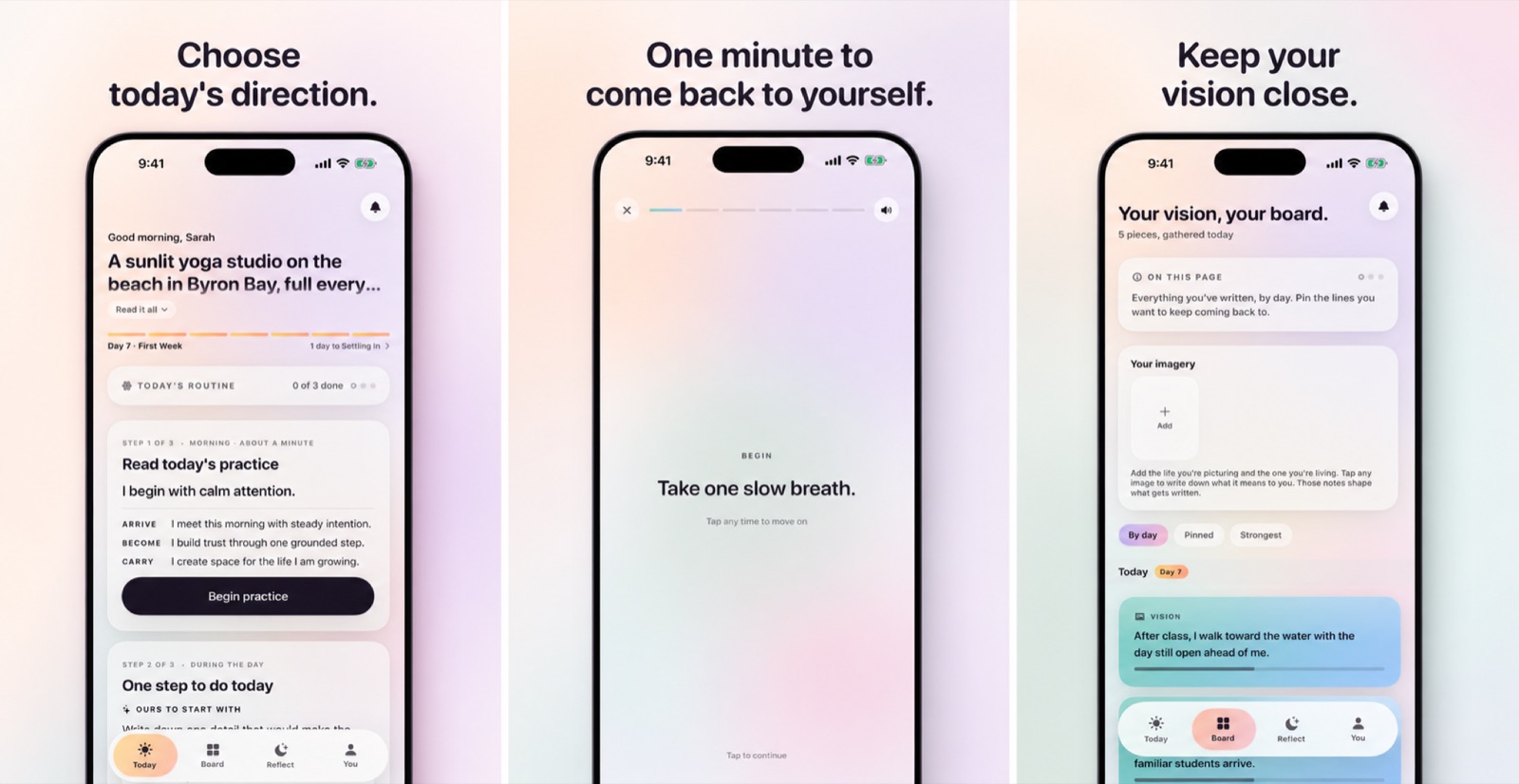
The short answer
Judge a manifestation app on five things, starting with whether the daily practice is short enough to repeat, whether it connects imagery to a real action, how it handles your private writing, whether it stays visible between sessions, and what it actually costs after the trial.
Why this page is not a ranking
Disclosure. This page is published by MyDirection, which makes one of the apps discussed. Our review method and conflict policy explains how we handle that.
Almost every "best manifestation apps" page you will find is published by one of the apps on it, and, remarkably, that app usually wins. The pattern is so consistent that the ranking itself has stopped carrying information.
We are in the same position, so we have taken the other option. Until we have completed hands-on scored tests of competitor apps under our published method (a named tester, a stated version, at least seven consecutive days each), we are not publishing a league table with our own product at the top of it.
What we can offer now is the framework we would use, written so you can apply it in an afternoon. It is more useful than a ranking anyway, because the best app in this category is genuinely person-dependent, and a table of scores tends to obscure that.
1. Practice design, or can you repeat it on a bad day?
This is the first filter and it eliminates more apps than any other. The question is not whether the practice is good. It is whether it still happens on the day you overslept, the week the deadline moved, the month everything went wrong.
Apps in this category tend to fail in one of two directions. Some are too heavy (a fifteen-minute audio session, a long journaling flow, a multi-step morning ritual), which works for a fortnight and then becomes the thing you are behind on. Others are too light, a single affirmation with nothing attached, which is pleasant and produces no consequence.
- What is the minimum viable session? If the shortest possible interaction still takes five minutes, it will not survive.
- Does it punish gaps? Streak counters make a missed day into a reason to quit. Prefer apps that record without grading.
- Is there a complete loop? Attention alone is daydreaming. Look for focus, action, reflection and evidence.
- Does more content mean better practice? Usually not. Large libraries are a content strategy, not a practice.
2. Vision-to-action, or does it ever touch a decision?
A vision board makes a goal salient. That is real and modest. The apps worth paying for do something with the salience. They convert it into a specific action, capture what happened, and use that to adjust.
This matters more than the category usually admits, because there is evidence that dwelling on an imagined outcome without pairing it to an obstacle and a plan can actually reduce the effort people put in. An app that is purely an inspiration delivery mechanism is not neutral.
- Does it ask for a specific action, or only for a feeling?
- Does it capture what actually happened afterwards, in a way you can read back?
- Does anything change as a result, such as the next prompt, the next step size, or what surfaces on the board?
- Can it tell you that a goal has stopped fitting, or will it cheerfully repeat a dead goal for a year?
See turning a vision board into daily action for the technique independent of any product, and what is an adaptive vision board for what "it changes" should actually mean.
3. Privacy, or what happens to what you write
You are about to hand an app your goals, photographs from your library, and a running account of how your life is going. That is a more revealing dataset than most people's social media, and it is produced at your least guarded.
The questions that actually distinguish products, in the order that reveals the most.
- Does it work without an account? An account means your content lives somewhere other than your device.
- Are photo images uploaded for AI features? Ask about images and captions separately. The answers often differ.
- What exactly is sent when AI features are on? A policy that says "your information" has not answered.
- Is there a genuine offline mode, or is offline an error state with a nicer name? Test it in Airplane Mode.
- Is analytics opt-in, and does turning it off stop collection or just stop reporting?
- Is content used for advertising or model training? Two separate questions.
- Can you delete everything from inside the app?
The full version with what a good answer looks like is in the private manifestation app checklist, and what each generation route is actually like to use is in on-device vs cloud AI.
4. Staying power, or is it visible between sessions?
The most underrated question in the category. An app you must remember to open is competing against every other app you must remember to open, and it will lose within a month.
Widgets, Lock Screen presence and watch complications are not cosmetic features here. They are the difference between a practice that exists in your day and one that exists in an app folder. A board on your Lock Screen is seen dozens of times without a decision. A board three taps deep is a physical board with extra steps.
| Surface | Why it matters | What to check |
|---|---|---|
| Lock Screen widget | Seen dozens of times daily with no decision | Does it show something useful, or a shrunken collage? |
| Home Screen widget | Present at the moment you reach for a distraction | Is the content current, or does it go stale? |
| Watch complication | Delivers at the moment of a decision | Readable in two seconds? Private enough for a shared space? |
| Notifications | Can rescue or destroy the practice | Two a day or twenty? Guilt-based or neutral? |
| Offline behaviour | Determines whether it works on a plane or a bad signal | Does the loop complete, or does it error? |
5. Price, or what it actually costs after the trial
Pricing in this category is deliberately hard to read. Weekly plans make the annual cost look small. Trials convert silently. "Free" apps are frequently free to install and paywalled at the first useful action.
Three things to establish before subscribing to anything.
- Is there a genuinely usable free tier, or only a trial? These are completely different and are marketed identically. A trial is a countdown; a free tier is a product.
- What is the annual cost? Multiply the weekly price by 52. The number is often startling and it is the number you will actually pay.
- When does the paywall appear? Before you can build a board, after the first session, or at the first useful feature? A paywall at the point of value is the worst version.
How to use a trial properly
Trials in this category are short, often three to seven days, and most people spend them exploring features, which tells you almost nothing about whether you will still be using the app in March.
- Set a calendar reminder for 24 hours before it ends, the moment you start. Do this before anything else; it is the difference between a decision and a charge.
- Use it on your worst day, not your best. A trial that only spans a quiet week tells you nothing about survival.
- Complete the full loop at least three times rather than touring the settings. The loop is the product.
- Run the Airplane Mode test and find the delete-everything control. Ten minutes, and it covers most of the privacy question.
- Check the annual price before you are attached. Multiply weekly plans by 52.
- Accept what a trial cannot show you. Anything that adapts needs weeks of input. Three days can tell you whether the rhythm fits your life, which is the more important question anyway.
If you are comparing two or three apps, run their trials sequentially rather than simultaneously. Overlapping trials produce a comparison of first impressions, and first impressions in this category are designed rather than earned.
The four kinds of app in this category
Most confusion about "which is best" comes from comparing products that are solving different problems. There are roughly four types, and the right question is which type you want before which product within it.
| Type | What it is for | Best when | Weakness |
|---|---|---|---|
| Collage and board builders | Making a beautiful board, often to print or share | The making is the point and you want a visual artefact | Usually no practice attached; the board goes stale |
| Affirmation and audio apps | Narrated stories, affirmations, ambient audio | You want emotional immersion and respond to audio | Passive; rarely touches a decision |
| AI image generators | Rendering an imagined future as an image | You find generated imagery motivating | Sends a description of private hopes to an image model; less recognition value than a real photo |
| Practice and adaptive apps | A daily loop of focus, action, reflection and evidence | You want the board to change something about today | Requires daily input; less visually impressive |
MyDirection is the fourth type. If you want the first or the third, we are not competing for you and a dedicated tool will do it better.
Seven red flags worth walking away from
Independent of which type of app you want, these are the signals that a product is optimising for something other than your practice.
- A paywall before you can see anything. Not a trial, but a wall between you and any sense of what the product does. It suggests the demo does not survive contact.
- Guaranteed outcomes. Any claim that the app will bring you money, love or a specific result. The evidence does not support it and the claim is designed to make failure your fault.
- A privacy policy that cannot enumerate what is sent. "Your information to improve your experience" means nobody has audited it, or the answer is uncomfortable.
- Streak-based guilt notifications. "You've broken your 12-day streak" is engagement design, and it reliably produces abandonment rather than practice.
- Reviews that all arrived in the same fortnight. Check the distribution over time, not just the average.
- No visible pricing until checkout. If the annual cost requires four taps to discover, that is a decision someone made.
- Vague scientific framing. "Neuroscience-backed" with no citation, "rewires your brain", "quantum". A product with real research behind it links to it.
None of these are automatically disqualifying on their own. Three of them together is a pattern.
The scoring model, if you want to run it yourself
This is the model we will use when scored tests are published, and there is nothing stopping you applying it to two or three shortlisted apps during their trials.
| Dimension | Weight | The question |
|---|---|---|
| Practice fit and repeatability | 20% | Would this still happen on your worst realistic day? |
| Vision-to-action continuity | 20% | Does imagery ever become a decision, and does anything adapt? |
| Privacy and control | 20% | Can you answer the seven privacy questions from the policy and the product? |
| Product quality | 15% | Stability, accessibility, native behaviour, clear offline states |
| Value | 10% | Annual cost, trial design, paywall timing |
| Personalization | 10% | Is it still relevant in week four, or has the variety run out? |
| Platform reach | 5% | Widgets, Watch, iPad, Android if you need it |
Two shortcuts if an afternoon is too much. Install two candidates, run the Airplane Mode test on both, and find the delete-everything control in each. That covers most of the privacy dimension in ten minutes. Then use each app on the worst day of the week rather than the best one; that covers the practice dimension better than a week of good days would.
Common questions
What is the best manifestation app?
There is no single answer, because these apps solve four different problems, collage building, audio and affirmations, AI imagery, and daily practice. Decide which type you want first, then compare within it.
Do manifestation apps work?
Not by causing external events. They can help by making a goal specific and salient, prompting consistent action, and supporting reflection, which is a narrower claim and a supportable one.
Are free manifestation apps any good?
Some are. Establish whether it is a genuine free tier or a trial, and what funds it. Advertising and data monetization both shape how your content is handled.
What should I check before subscribing?
The annual cost, when the paywall appears, whether it works offline, whether analytics is on by default, and whether you can delete everything from inside the app.
Why does this page not rank the apps?
Because we make one of them and have not completed hands-on scored tests of the others. Publishing a ranking with our own product in it before that would be worth nothing.
Is MyDirection the best choice?
For a short daily practice that adapts to your reflections, with an explicit privacy choice, on iPhone and Apple Watch. It is what we built. If you want a collage tool, an image generator, narrated audio, an Android app or a free tier, it is not.
For iPhone and Apple Watch
Keep your vision close.
Become it daily.
MyDirection is a paid subscription with a 3-day free trial. Cancel any time before the trial ends and you are not charged.
See pricing and trial