
Vision boards, explained
What is a vision board?
A picture of the future, and, if you build it properly, a prompt for the present.
See pricing and trial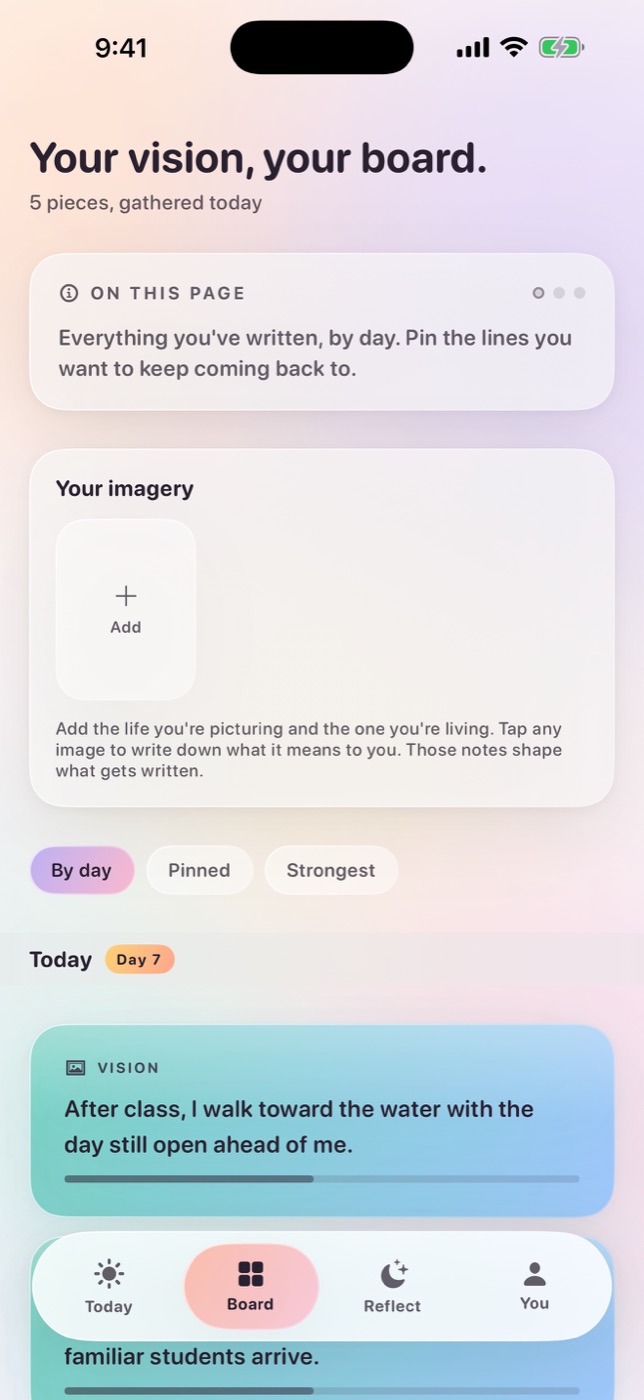
The short answer
A vision board is a collection of images, words and symbols representing a direction you want to move toward. It works by making an abstract goal concrete enough to notice regularly. It does not attract outcomes; it changes what you pay attention to, which changes what you choose.
The definition, without the mysticism
A vision board is a curated set of images, words and symbols that represents a direction you want your life to move in. It might be a corkboard, a page in a notebook, a Photos album, a Pinterest board or an app. The format matters far less than most guides suggest.
The idea entered mainstream culture through law-of-attraction literature, which is why it usually arrives wrapped in claims about frequency, energy and the universe responding to your thoughts. Those claims are not what makes a board work, and you can discard them entirely without losing the technique.
The mechanism is simpler and better supported. Goals held only as words are abstract, easy to postpone and easy to forget. Goals rendered as concrete images are easier to recall, easier to recognise when a relevant opportunity appears, and harder to quietly redefine when they become inconvenient. A vision board is an attention device.
How a vision board actually works
Three effects do the real work, and none of them require anything supernatural.
- Specificity
- Choosing images forces you to decide what you actually mean. "Be healthier" is unfalsifiable. Choosing a photograph of a specific activity in a specific setting forces a decision about which version of healthier you want, and specific goals are consistently associated with better follow-through than vague ones.
- Salience
- Something you see daily stays available in memory. When an opportunity appears that is relevant to it (a conversation, a listing, an invitation) you are more likely to recognise it as relevant. This is unremarkable cognitive housekeeping rather than magic, and it is genuinely useful.
- Emotional pull
- Imagery produces a motivational response that a written objective usually does not. That pull is fuel. It is also the part that can go wrong, which is the subject of the next section.
Notice what is absent from that list, which is any claim that the board influences external events. Nothing about a picture on a wall changes the world. It changes you, slightly, in a direction that makes certain choices marginally more likely, and marginal changes to daily choices, sustained over a year, are how most real change actually happens.
What a vision board cannot do
This is the section most guides omit, and it is the one that determines whether your board helps or quietly hurts.
First, a board cannot replace decisions, skill-building, resources, support or time. If the direction requires a qualification, someone else's agreement, or eighteen months, no amount of looking at it compresses that.
Second, and this is the counterintuitive one, vividly imagining a desired outcome can reduce the effort you put toward it. Research on positive fantasies has repeatedly found that indulging in the imagined outcome can lower energy and predict poorer performance, apparently because the mind experiences a portion of the reward in advance. A vision board built purely as an outcome fantasy is not neutral; it can actively work against you.
The antidote in the research is mental contrasting, pairing the desired future with a clear-eyed look at the present obstacle, and then attaching a specific plan to the obstacle. Practically, that means your board should contain the process as well as the prize, and it should be attached to something you do, which is the whole argument for pairing a board with a daily action. See turning a vision board into daily action.
What belongs on a vision board
Choose images that make the direction observable. The test for any candidate image is whether it helps you recognise the thing when it appears in your actual life.
- The environment. The room, street, studio, landscape or workspace where this life happens.
- The routine, what an ordinary Tuesday looks like, not just the milestone day.
- The people, who is around, what the relationships look like, who you are learning from.
- The feeling. An image that captures the quality of the life rather than its inventory.
- The evidence, what would exist if this were real. A shipped product, a full calendar, a quiet weekend.
- Your own photographs, wherever possible. Recognition beats aspiration.
What to leave off is other people's bodies as a stand-in for your health, income figures with no attached work, and images that produce envy rather than pull. The distinction is worth taking seriously. An image that makes you feel behind is not motivating you, it is taxing you every time you see it.
Fewer, more meaningful images beat a crowded board. A board with sixty images has no focal point, which means it communicates nothing in the three seconds you actually give it. See vision board ideas for category-by-category suggestions.
How often to revisit it
Daily, briefly. A short glance that ends in a useful question about what would move this forward today is worth more than a long contemplative session once a month. The purpose of the daily look is not to feel inspired; it is to make the direction present before the day fills up with other people's priorities.
Then review the whole board monthly, or whenever the goal changes. The monthly review asks different questions, like whether this is still what I want, which parts have gone stale, what evidence have I actually collected, and what should come off. A board nobody ever removes anything from becomes an archive of former selves.
Expect the board to change. Most people's direction is meaningfully different at month six than it was at month one, not because they failed but because they learned something. A board that cannot change turns that learning into guilt.
Where the idea came from, and why that matters
Vision boards entered popular culture through law-of-attraction literature in the mid-2000s, which is why the technique usually arrives packaged with claims about frequency, energy and the universe responding to thought. That packaging is the reason a lot of otherwise pragmatic people dismiss the whole idea.
The underlying practice is much older and considerably less exotic, from athletes rehearsing a routine mentally, designers keeping mood boards, planners using visual references to keep a long project coherent. None of those are described as attracting anything. They are described as ways of keeping a complex intention specific and available.
The distinction matters practically. If you believe the board causes outcomes, the rational response to a bad month is to believe harder, and the technique quietly becomes a way of avoiding the thing that would actually work. If you understand the board as an attention device, the rational response to a bad month is to look at what you did and change something, which is a response that has somewhere to go.
Digital or physical?
Physical boards create a tactile ritual and a screen-free object in your environment. The making is genuinely part of the value, because cutting, arranging and committing to a layout forces decisions that dragging files does not. The cost is that a physical board is only visible where it hangs, is awkward to change, and is on display to anyone in the room.
Digital boards travel with you, update easily, and can attach to reminders, widgets and daily prompts. The cost is that they live on a device full of competing demands, and that your private hopes are now inside a product with a business model. Which is why the privacy questions in the private app checklist are worth asking before you commit.
The better format is the one you will actually revisit. A hybrid works well, so make the physical board, photograph it, and use a digital practice to carry the direction into your day. Full comparison in digital vs physical vision boards.
Common questions
Do vision boards actually work?
They work as attention tools, making a goal specific and keeping it salient, which influences what you notice and choose. They do not cause external events. A board paired with a daily action outperforms a board on its own by a wide margin.
How many images should a vision board have?
Few enough to have a focal point. Most people do better with under fifteen. A crowded board communicates nothing in the seconds you actually give it.
Should I put money amounts on my vision board?
Only alongside the work that would produce them. A number with no attached process is the clearest example of an outcome fantasy, which research suggests can reduce effort rather than increase it.
When should I make a vision board?
Whenever a direction becomes clear enough to picture. January is traditional and irrelevant; a board made in March that reflects a real decision beats a board made on schedule.
Can I have more than one vision board?
You can, but attention is the scarce resource. Two boards usually means neither gets a daily glance. One direction at a time is a constraint worth accepting.
Sources and further reading
For iPhone and Apple Watch
Keep your vision close.
Become it daily.
MyDirection is a paid subscription with a 3-day free trial. Cancel any time before the trial ends and you are not charged.
See pricing and trial