
A new category
What is an adaptive vision board?
Every vision board is a snapshot of the day you made it. An adaptive one keeps up.
See pricing and trial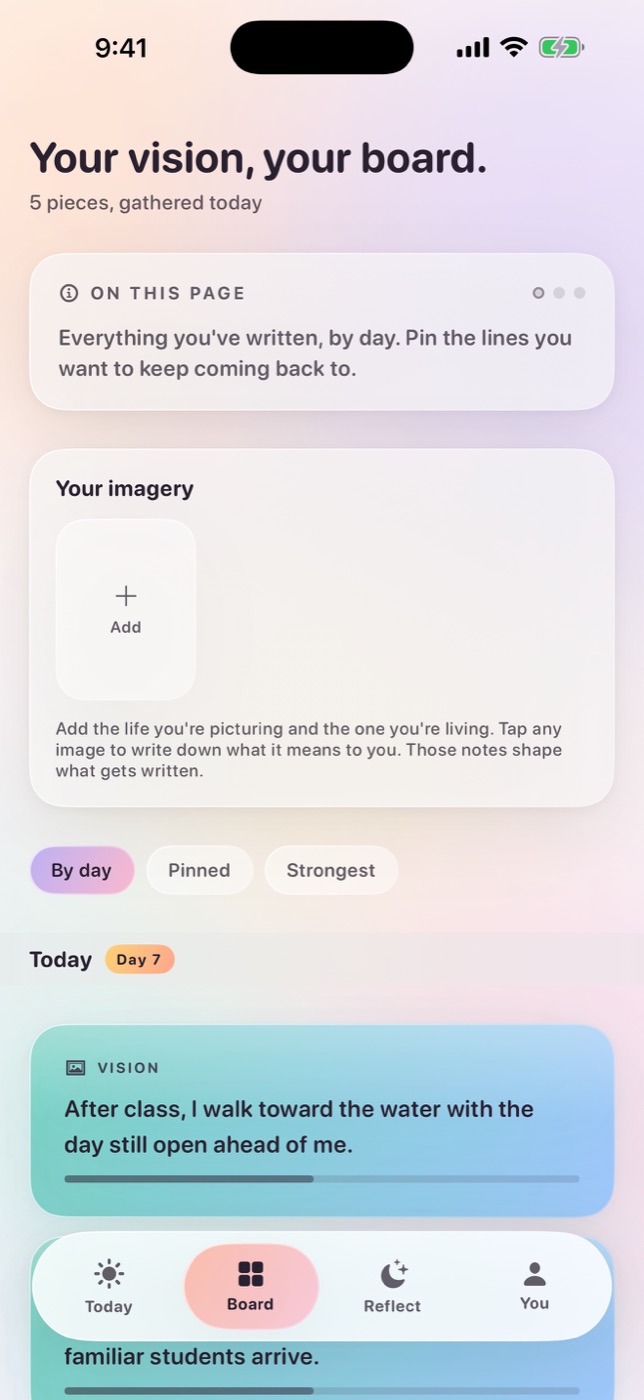
The short answer
An adaptive vision board is a board that changes based on the signals you produce while using it, meaning which lines you respond to, which actions you complete, and what you write in reflection. A static board records intentions from one day; an adaptive board tracks a direction as it moves.
The problem with a board that cannot change
A vision board is made in a moment of clarity. You know what you want, you find the images, you arrange them, and for about two weeks the board does exactly what it should. It makes an abstract direction concrete and keeps it in view.
Then two things happen at once. The board becomes visually invisible, since habituation is fast and completely normal, and your life moves on without telling it. You changed jobs in March. The relationship in that photograph ended. The business model you pictured turned out to be wrong in an interesting way, and the interesting way is now the actual direction. The board knows none of this, because a collage has no input channel.
What you are left with is an artefact that describes a person you were. Looking at it produces a small, specific discomfort most people cannot name, a mixture of guilt about the goals you dropped and vague obligation toward a version of yourself you no longer are. Eventually you stop looking, which resolves the discomfort and ends the practice.
What makes a board adaptive
Adaptive is not the same as editable. Almost every digital vision board is editable. You can add and remove images whenever you like. That places the entire burden on you, since you must notice the drift, decide what it means, and do the work.
The trouble is that drift is precisely the thing you do not notice. If you were able to spot the moment your goal quietly stopped being yours, you would not need the board to tell you.
An adaptive board changes in response to signals you are already producing, without asking you to make a decision about the board itself. Three properties define it.
- It takes input from behaviour
- It knows which actions you completed and which you abandoned, and how large they were.
- It takes input from reflection
- It reads what you wrote about how the day went, not just whether you opened the app.
- It changes what it surfaces
- Rather than showing you the whole board every day, it brings forward the part that is relevant to where you actually are.
A board that does all three is adaptive. A board that does none of them is a collage with a notification attached, however sophisticated the image generation is.
The three signals, and what each one is good for
Adaptation is only as good as its input. These are the three signals worth collecting, in ascending order of usefulness.
| Signal | What it captures | What it can change | Weakness |
|---|---|---|---|
| Response | Which lines you engage with, skip or mark as not landing | Register, tone and subject of the next line | Cheap to collect, easy to over-read; a skip may just mean you were busy |
| Behaviour | Which steps you completed, which you abandoned, and their size | The size and type of the next suggested step | Tells you what happened, not why |
| Reflection | What you wrote about the day and how aligned it felt | Which part of the direction surfaces, and when to ask if the goal still fits | Requires effort from you, so it must be cheap to give |
Reflection is the highest-value signal and the one most products fail to collect, because collecting it requires asking the user to do something. The design answer is to make the minimum viable reflection genuinely minimal (a single tap should be a complete, valid entry) so that the signal keeps arriving on the days when writing is out of the question.
One design decision matters more than the algorithm, which is that recent signals should outweigh old ones. Learning that accumulates forever will keep optimising for the person you were in March. Learning that decays keeps describing the person you are now, which is the entire point.
Adaptive vs static, compared
| Static board | Editable digital board | Adaptive board | |
|---|---|---|---|
| Changes when | You remake it | You remember to edit it | Your behaviour and reflections change |
| Knows what you did | No | No | Yes |
| Knows what landed | No | No | Yes |
| Shows you | Everything, always | Everything, always | The relevant part, now |
| Handles a changed goal | Becomes wrong | Becomes wrong until you notice | Asks whether the goal still fits |
| Contains evidence | Rarely | Sometimes | By design |
| Maintenance burden | High, occasional | Medium, continuous | Low |
| Best at | Ritual and tactile focus | Portability and easy edits | Staying relevant over months |
None of this makes a physical board bad. The making of one is genuinely valuable, and a screen-free object in your environment has real advantages. See digital vs physical. The question adaptive boards answer is narrower, namely what keeps a board useful in month three, when the initial energy is gone and your circumstances have quietly moved.
The loop that makes adaptation possible
A board cannot adapt to nothing. Adaptation requires a loop that produces signals, and the loop needs four parts to produce signals worth having.
- Attention. A short daily moment where one thing from the board is surfaced. This produces the response signal.
- Action. One specific step, sized to finish today. This produces the behaviour signal and, more importantly, produces consequences in the world.
- Reflection. A short evening entry on what happened and how aligned it felt. This produces the reflection signal.
- Evidence. A record of what actually occurred, including what did not work. This is what the board becomes over time.
Remove any one and adaptation degrades in a predictable way. Without attention there is nothing to respond to. Without action there is no consequence to reflect on, and the board learns only about your moods. Without reflection you have activity data and no meaning. Without evidence the practice has no memory, and you rebuild the same conclusions every six weeks.
This is also why an adaptive board is inseparable from a daily practice. You cannot bolt adaptation onto a collage, because a collage produces no signal. See turning a vision board into daily action.
Why this became possible recently
Adaptive boards are not a new idea so much as a newly practical one, and the reason is worth understanding because it tells you what to expect next.
The hard part was never storing your reflections. It was reading them. A system that adapts to free-form writing has to understand what a sentence like "got through it but the whole thing felt pointless" actually indicates, and that was not reliably possible in a consumer app until language models became cheap enough to run per user, per day, and small enough to run on the device itself.
That is why this category is filling up now, and also why so much of it is superficial. The same capability that allows genuine adaptation also makes it trivial to generate infinite variations of an affirmation, which looks similar in a screenshot and is a completely different product. The differentiator is not whether an app uses a model. It is whether anything persists and changes as a result.
What adaptive does not mean
The word is going to be used loosely as this category grows, so it is worth marking the boundaries now.
- It does not mean AI-generated imagery. Generating pictures of your imagined future is an image feature. It says nothing about whether the board responds to you.
- It does not mean personalized affirmations. A model writing from a category ("career," "abundance") produces variety, not adaptation. Variety runs out in about a fortnight.
- It does not mean reminders. A notification is a delivery mechanism. The board is unchanged.
- It does not mean a chatbot. Conversation is an interface. What matters is whether anything persists and changes the board.
- It does not mean it decides for you. Adaptation should surface and suggest. The direction stays yours, including the decision to change it.
The test to apply to any product claiming this is simple. After four weeks of ordinary use, is the board showing you something different from what it showed in week one, and can you trace the difference to something you actually did? If not, it is a static board with a generator attached.
The real risks of an adaptive board
There are real downsides, and a page written by the people who make one should say what they are.
Adaptation needs data, and data is your private writing. A board that learns from your reflections requires your reflections. That is a genuine privacy cost, and the only acceptable answer is an explicit choice about how that content is handled, made before you write anything. Ours is here; the questions to ask anyone else's are here.
Responsiveness can become drift. A system that adapts too eagerly to short-term signal will chase a bad fortnight into a changed direction. Decay should be slow enough that a hard week does not rewrite your goal.
Adaptation can be used to increase engagement rather than usefulness. The same machinery that surfaces a relevant line can surface the line most likely to make you open the app. Those are different objectives and they diverge quickly. The check is whether the product profits from your attention or from a subscription.
It can become something you outsource to. A board that decides everything removes the reflective work that makes the practice valuable. Suggesting is useful; deciding is not.
What adaptation looks like over three months
Adaptation is often marketed as something you feel immediately. You do not, and a product claiming otherwise is responding to your onboarding answers rather than to your behaviour. The realistic timeline.
| Period | What the board knows | What changes |
|---|---|---|
| Days 1–3 | Your stated direction and preferences | Almost nothing. The writing is broadly relevant and slightly generic |
| Week 1 | Which steps you finished and how big they were | Step suggestions start being sized to your actual day |
| Weeks 2–3 | Which lines you engaged with or skipped | Register and subject shift toward what lands |
| Weeks 4–6 | A month of reflections and their alignment ratings | Different parts of the board surface at different moments; your own phrasing appears |
| Weeks 7–10 | Patterns across reflections, including repeated friction | The evening prompt starts targeting the obstacle rather than the day |
| Month 3+ | A body of evidence and a trajectory | Drift becomes visible, and the direction question gets asked when the pattern warrants it |
The implication for anyone evaluating a product in this category is that a short trial cannot demonstrate adaptation. Three reflections is not enough input to adapt to. What a trial can show you is whether the daily rhythm fits your life, which is the more important question anyway. Adaptation is worthless in a practice you abandon in week two.
How to build an adaptive practice without any app
You do not need software for this. You need a loop and a review. A notebook version.
- Write your direction as one sentence on the first page.
- Each morning, write one line from the direction and one step, with a trigger in the form when X, I will Y.
- Each evening, write one line on what happened and rate alignment out of five.
- Each week, read the seven entries and answer what moved, where the friction was, whether the step is the right size and whether the direction still fits.
- Each month, revise the board itself, remove what has gone quiet, add evidence of what actually happened, and rewrite the direction sentence if it no longer describes what you want.
That is an adaptive vision board. It is slower than software, the review is manual, and it will work. What an app adds is that the review happens continuously rather than when you remember, and that the surfacing is automatic rather than requiring you to decide what to look at.
MyDirection is our implementation of exactly this loop. We would rather you ran the notebook version than nothing at all.
Common questions
What is an adaptive vision board?
A vision board that changes based on signals you produce while using it (which lines you respond to, which actions you complete, and what you write in reflection) rather than staying fixed at the moment you made it.
How is it different from a digital vision board?
Most digital boards are editable, which still requires you to notice drift and act on it. An adaptive board changes in response to signals you are already producing, without you deciding to change it.
Does adaptive mean AI-generated images?
No. Image generation is a separate feature and says nothing about whether the board responds to you. A board can be fully adaptive with only your own photographs.
Can I make an adaptive vision board myself?
Yes. A notebook, a daily line and step, an evening rating, a weekly review and a monthly board revision covers the whole mechanism. Software makes the review continuous rather than manual.
What is the risk of a board that adapts?
It needs your private reflections to learn from, it can over-react to a bad fortnight, and the same machinery can be pointed at engagement instead of usefulness. Ask how the product makes money.
How long before adaptation becomes noticeable?
Realistically a few weeks, long enough for a pattern to appear in your own entries. Anything that appears to adapt on day three is responding to your onboarding answers, not to your behaviour.
For iPhone and Apple Watch
Keep your vision close.
Become it daily.
MyDirection is a paid subscription with a 3-day free trial. Cancel any time before the trial ends and you are not charged.
See pricing and trial