
Editorial method
How we review apps
We make an app in this category. Here is the method that makes our comparisons checkable anyway.
See pricing and trial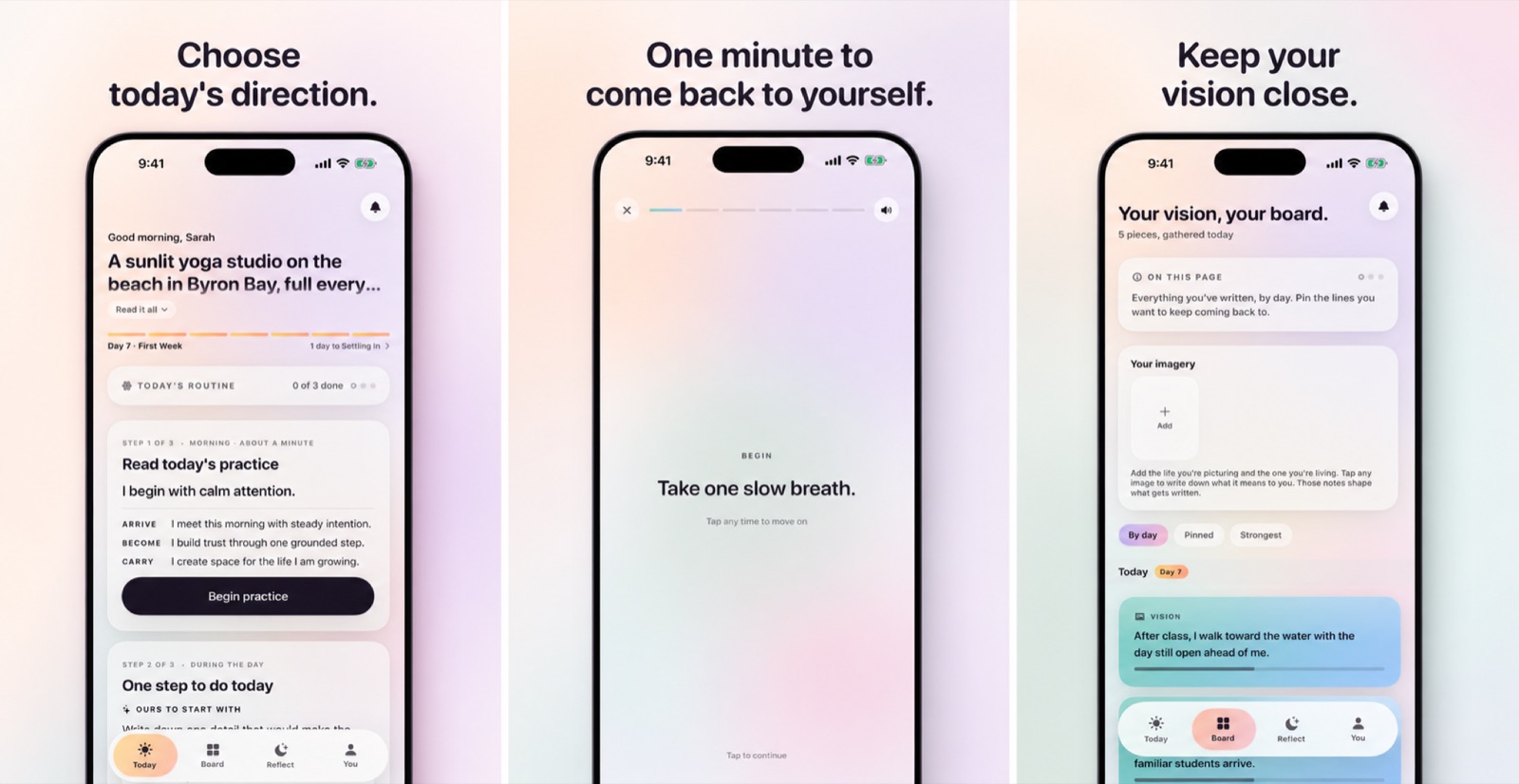
The short answer
We publish a fixed scoring model across seven weighted dimensions, disclose that MyDirection publishes every comparison, never describe an app as tested unless a named person used a stated version for a stated period, and mark pages clearly where a hands-on test has not yet been completed.
The conflict of interest, stated first
MyDirection is a manifestation and vision-board app. We also publish comparison content about manifestation and vision-board apps. That is a conflict of interest, and no amount of careful writing removes it.
What we can do is make it checkable. Every comparison page states that MyDirection publishes it. The scoring model is published in advance rather than reverse-engineered to produce a convenient result. And MyDirection is not eligible to be named an overall winner on any comparison page until it has been tested against the same rubric, on the same released build basis, as every competitor on that page.
Where a page recommends a competitor, that is not generosity but the model working. An evaluation framework that can never produce an inconvenient answer is not a framework.
The scoring model
Every scored comparison uses these seven dimensions with these weights. The weights reflect what we think determines whether someone is still using an app in month three, and you are free to disagree, which is exactly why they are published rather than implied.
| Dimension | Weight | What is measured |
|---|---|---|
| Practice fit and repeatability | 20% | Daily time required, clarity, reminders, friction, whether it survives a bad week |
| Vision-to-action continuity | 20% | Whether imagery connects to a next action, reflection, evidence and adaptation |
| Privacy and control | 20% | Account requirement, storage, photo handling, AI data flow, analytics defaults, export and deletion |
| Product quality | 15% | Stability, accessibility, native behaviour, editing, offline states, error handling |
| Value | 10% | Usable free experience if any, trial design, annual price, paywall timing |
| Personalization | 10% | Relevance, user control, transparency, quality on repeat use |
| Platform reach | 5% | iPhone, iPad, Android, widgets, Watch |
Privacy carries the same weight as practice design deliberately. In a category where the product holds your goals, photographs and reflections, we do not think a better interface compensates for an unclear data flow.
Testing conditions
When we say an app was tested, all of the following are true and stated on the page.
- A named person used it, on a stated device and OS version, for a stated period of at least seven consecutive days.
- The app version number is recorded, along with the date the test began and ended.
- The daily loop was completed as a real user would, with a genuine goal rather than filler.
- Prices were captured in a named App Store region on a stated date, including trial length and conversion behaviour.
- Privacy behaviour was checked against the product, not inferred from marketing, using an Airplane Mode test, analytics defaults, deletion controls, and the relevant paragraphs of the policy.
- Screenshots used are original captures from that test, not vendor marketing assets.
If any of those is missing, the page does not use the word tested. It says what was examined instead, for example that a comparison is based on publicly available material as of a given date.
Claims discipline
Rules that apply to every page we publish, product pages included.
- We do not claim that thought alone causes external outcomes. Where research is cited, the claim is limited to what the study supports.
- We do not infer privacy behaviour from marketing language. If a question is unanswered, the page says it is unanswered.
- Prices carry a region and a date. A trial is never described as a free tier.
- We do not make mental-health treatment claims, and content touching distress, compulsion or clinical care carries an appropriate boundary.
- We disclose ownership, free access, sponsorship and any affiliate relationship. We currently have no affiliate relationships in this category.
- Product facts about other apps are sourced to App Store listings or vendor documentation, with the date checked.
How we source and cite
Two kinds of claim appear in our content and each has its own rule.
Product facts about other apps are sourced to the vendor's own material (the App Store listing, the product site, or the privacy policy) with the date we checked it. Where a vendor's material does not answer a question, we say the question is unanswered rather than inferring an answer from what the marketing implies. Where we have contacted a vendor and had no response, we say that too.
Research claims are cited to primary papers rather than to a secondary write-up of them, and the claim is limited to what the study actually supports. This matters in a category built on overstatement, because a study finding that positive fantasies reduced effort in a specific experimental context supports a specific, hedged sentence, and it does not support "science proves visualization doesn't work." We would rather write the hedged sentence.
Where a page has no sources listed, it is because the content is descriptive of our own product or is straightforward practical instruction, not because a claim went unsupported.
Corrections and updates
Every page shows a published date and an updated date. Material changes (a price change, a feature removal, a privacy policy revision, a changed recommendation) are made visibly rather than silently edited, and the reason is recorded on the page.
If you are a vendor and we have described your product inaccurately, write to us with the correction and we will check it and fix it. That includes cases where the correction makes your product look better than our page currently does.
If you are a reader and something here does not match what the app actually does, we want to know that even more. The contact address is on our privacy policy.
How a score is actually produced
So that a published number means something specific rather than reading as a general impression.
- Each dimension is scored 1–5 against written criteria fixed before testing begins, not adjusted afterwards to fit a conclusion.
- Scores are recorded per dimension with a one-line justification and, where relevant, the screenshot or setting that supports it.
- The weighted total is calculated from the published weights. It is not adjusted for an overall impression.
- Any dimension that could not be assessed is marked unassessed rather than given a neutral score, and the page says which.
- Every scored page states the app version, the test dates, the device and OS, and the App Store region used for prices.
- Where a score would change a recommendation, the reasoning is written out rather than left implicit in the number.
A consequence worth stating is that an app can score well overall and still be the wrong choice for you, because the weights encode our judgement about what matters and yours may differ. That is why the weights are published. You can re-weight them yourself in a few minutes and get a different, equally legitimate answer.
What this method does not yet cover
Two gaps we would rather state than have discovered.
We have not yet named an individual editor. Our pages currently carry a team byline. A named responsible editor and tester is a requirement of this method and it will be in place before any scored comparison is published.
We have not yet published the underlying research assets. The privacy index and price index that would let you check a comparison's inputs rather than trusting its conclusions. Those are in progress. Until they exist, treat our comparison pages as frameworks for your own evaluation rather than as verdicts.
Common questions
Do you accept payment for reviews or placements?
No. There are no affiliate relationships, sponsored placements or paid inclusions in our comparison content.
Can MyDirection win your own comparisons?
Not until it has been tested against the same rubric and on the same basis as every competitor on that page. Currently no scored comparisons are published.
Why does privacy carry 20% of the score?
Because the product holds your goals, photographs and reflections. In this category a better interface does not compensate for an unclear data flow.
How do you verify privacy claims?
By testing behaviour rather than reading marketing, using Airplane Mode, analytics defaults, in-app deletion, and the specific policy paragraphs on photos, training, retention and advertising.
What happens when an app changes after you review it?
The page gets an updated date and a visible note. Prices and privacy policies change often enough that an undated comparison is not worth reading.
For iPhone and Apple Watch
Keep your vision close.
Become it daily.
MyDirection is a paid subscription with a 3-day free trial. Cancel any time before the trial ends and you are not charged.
See pricing and trial