
From imagery to decisions
Turning a vision board into daily action
The board supplies the pull. This is the part that supplies the movement.
See pricing and trial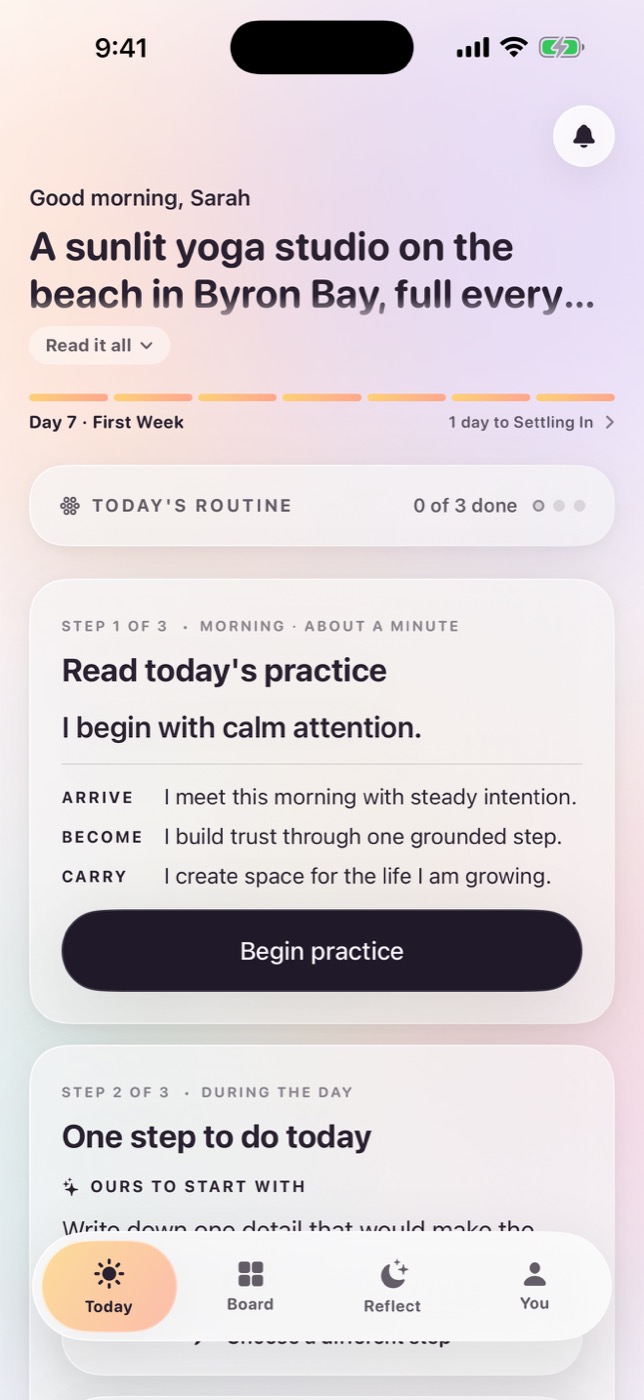
The short answer
Convert a vision board into action by attaching one implementation intention to it ("when X happens, I will do Y"), sized small enough to finish on a bad day. Then diagnose friction rather than motivation, and review weekly whether the step size and direction still fit.
The gap between a board and a changed week
A vision board reliably does one thing. It makes a direction salient. That is genuinely useful and it is not sufficient, because salience does not survive contact with a calendar. At 9:15 the direction is clear and at 9:20 you are answering an email about something else entirely, and the board has no mechanism to intervene.
Worse, there is evidence that vividly picturing a desired future can reduce the effort you put into pursuing it, because the mind banks part of the reward in advance. That means a board used purely as an inspiration ritual is not neutral. It can be quietly counterproductive.
The fix in the research literature is not more visualization but mental contrasting, pairing the imagined future with the actual present obstacle, followed by a specific plan attached to that obstacle. This guide is the practical version of that.
Step one, contrast the future with the obstacle
Spend two minutes on this once, and revisit it monthly. It is the highest-leverage two minutes in the whole practice.
- Picture the direction as if it were already true. Be specific about what an ordinary Tuesday looks like.
- Now ask what actually stands between here and there. Not the world's obstacles, but yours.
- Name the single biggest one in concrete terms. Not "lack of discipline" but "I have no protected time before 6pm."
- Write one plan attached to that obstacle in the form when X happens, I will do Y.
The concreteness of step three is what makes step four possible. "Lack of discipline" has no plan attached to it because it is not a thing that happens at a time. "No protected time before 6pm" has several. A calendar block, an earlier start, a different commute, one fewer commitment.
Step two, write one implementation intention
An implementation intention is a plan in the form "when situation X arises, I will perform response Y." The evidence for this format is unusually consistent across domains, and the mechanism is simple, since it delegates the decision to a cue, so you do not have to negotiate with yourself at the moment of action.
| A goal intention (weak) | An implementation intention (strong) |
|---|---|
| I'll work on the portfolio more | When I finish breakfast, I will spend 25 minutes on the portfolio before opening email |
| I'll network more this year | When I finish a project, I will message one person from it that same day |
| I'll exercise regularly | When I close the laptop at 5:30, I will put on running shoes before sitting down |
| I'll write more consistently | When the kettle goes on, I will open the draft and write one paragraph |
Two rules. The trigger must be something that reliably happens, an existing routine rather than a feeling. "When I feel motivated" is not a trigger. It is a hope. And the response must be a specific physical action rather than a category of work; "open the draft and write one paragraph" starts, "work on writing" does not.
Step three, size the step for a bad day
The most common failure is a step sized for the day you wish you had. It works for four days, meets a genuinely difficult one, breaks, and takes the practice with it.
So size it for the bad day. Whatever you first wrote, halve it. If a halved version still feels like it needs a good day, halve it again. The goal in the first fortnight is not progress but establishing that the practice happens regardless of conditions.
- Too big
- Requires more contiguous time than your worst realistic day contains.
- Too vague
- You would not know whether you had done it. "Work on outreach" fails; "send three messages" passes.
- Too adjacent
- Comfortable, related, and not on the actual constraint. Reorganising your files is the classic.
- About right
- Finishable in a bad hour, obviously either done or not, and pointed at the real obstacle.
Increase only when you have finished early three times in a row. Increase because the step is too small, not because you feel you ought to be doing more.
Step four, diagnose friction rather than motivation
When a step is missed, the default question is "why didn't I do it," and every available answer is about your character. That question has never once produced a useful action.
Replace it with a better question. What made this harder than expected? Friction is almost always structural, and structural problems have fixes.
| Friction | Looks like | Fix |
|---|---|---|
| Ambiguity | You knew the task, not the first move | Write the first physical action, not the task |
| Setup cost | Four things had to be opened first | Do the setup the night before |
| Size | It needed 90 minutes and you had 20 | Halve it, twice if necessary |
| Timing | The trigger lands during your busiest hour | Move the trigger, not the task |
| Emotional cost | It required an uncomfortable ask | Name the discomfort; shrink the ask to its smallest version |
| Wrong target | It was adjacent to the goal | Identify the actual constraint and aim at that |
| Wrong goal | You dread it and cannot say why | Stop and revisit the direction. This is information |
That last row matters. Persistent, unexplained reluctance is usually not laziness. It is frequently a goal that belongs to someone else, and it will not respond to better systems.
Step five, the weekly review
Ten minutes, once a week. Read the week's entries rather than recalling them, because memory heavily over-weights the last two days and will tell you a week was a failure on the basis of Friday.
- What moved? List concrete things, including the ones that produced nothing.
- Where was the friction? Use the table above and name the category.
- Is the step the right size? Three early finishes means increase. Three misses means halve.
- Is the trigger reliable? If you missed the trigger rather than the task, change the trigger.
- Does the direction still fit? Ask it plainly and answer based on what has actually happened.
This review is the mechanism that makes a board adaptive whether or not you use software, see what is an adaptive vision board.
A one-week experiment you can run now
If you want to test whether this changes anything before committing to it, run this for seven days. Paper is fine.
- Day 0. Write your direction in one sentence. Name the single biggest obstacle. Write one implementation intention. Halve the step.
- Days 1–7, morning. Read the direction sentence. Take one breath. Confirm today's step in the when-then form.
- Days 1–7, evening. One line on what happened, and a 1–5 alignment rating. Two minutes maximum.
- Day 7. Read all seven entries in one sitting and answer the five review questions.
- Then decide. Was the step the right size? Was the trigger reliable? Did the direction hold? Adjust one thing, only one, and run it again.
Most people learn two things in the first week, that the step was too big and that the trigger was attached to a feeling rather than an event. Both are fixable in a minute, and both would have gone undiagnosed for months without the review.
Common questions
How do I turn my vision board into action?
Attach one implementation intention to it in the form "when X happens, I will do Y," sized small enough to finish on a bad day. Then review weekly whether the step size, the trigger and the direction still fit.
What is an implementation intention?
A plan in the form "when situation X arises, I will perform response Y." It works by delegating the decision to a cue, so you do not renegotiate with yourself at the moment of action.
How big should a daily step be?
Small enough to finish on your worst realistic day. Whatever you first write, halve it. Increase only after finishing early three times in a row.
What if I keep missing the step?
Diagnose the friction rather than your motivation, looking at ambiguity, setup cost, size, timing, emotional cost, wrong target or wrong goal. Each has a specific fix; "try harder" does not.
How often should I review?
Weekly for step size and friction; monthly for the board and the direction itself. Reading entries beats recalling them, because memory over-weights the last two days.
Does visualization help at all?
As a way of getting specific about the direction, yes. As a substitute for planning, no, because dwelling on the outcome alone can reduce effort. Contrast it with the obstacle and attach a plan.
Sources and further reading
For iPhone and Apple Watch
Keep your vision close.
Become it daily.
MyDirection is a paid subscription with a 3-day free trial. Cancel any time before the trial ends and you are not charged.
See pricing and trial