
Reflection with a purpose
Manifestation journal prompts
Write to notice. Not to perform certainty.
See pricing and trial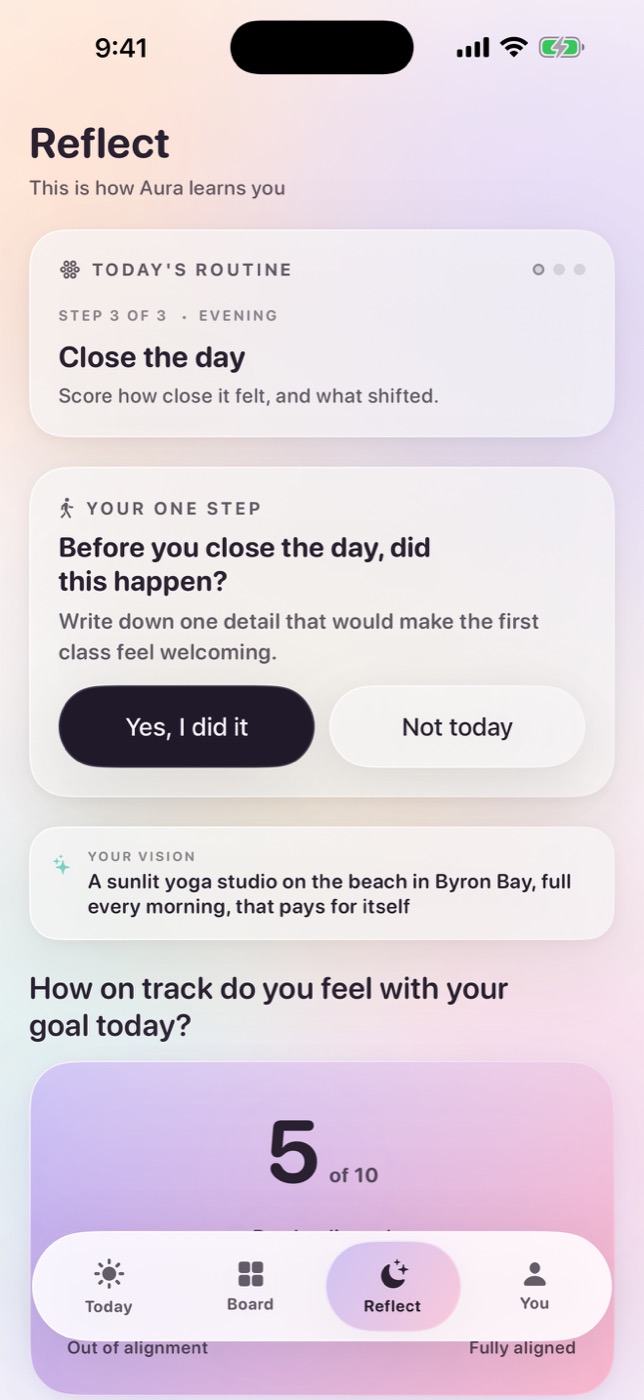
The short answer
The most useful manifestation journal prompts ask about observable things, like what you would notice today, what evidence appeared, what made the step harder than expected, and whether the goal still feels like yours. Prompts that demand certainty produce performance rather than insight.
Why most manifestation journaling produces nothing
The standard advice is to write your desire in the present tense, repeatedly, until it feels true. Scripting, 369, the same sentence thirty-three times. The theory is that repetition changes belief and belief changes reality.
The practical result, for most people, is a notebook of increasingly hollow sentences. Repetition adds no new information, so the hundredth writing is no more convincing than the first, and if the statement conflicts with what you currently believe about yourself, research suggests it can leave you feeling worse rather than better.
A journal earns its place when it produces something you did not have before you opened it, whether a noticed pattern, a named obstacle, a piece of evidence you would have forgotten, or the recognition that a goal has quietly stopped being yours. Every prompt below is built for that.
The morning prompt, making the direction observable
If this direction mattered today, what would I notice, and what is one step I could take?
This prompt does two jobs in one sentence. "What would I notice" primes attention, which is the actual mechanism a vision board relies on. "One step" converts it into something with a physical consequence.
Answer in under a minute. Two lines is plenty. If you find yourself writing a paragraph most mornings, the direction is probably too abstract. A specific direction produces a specific answer quickly.
Variations worth rotating in include What would the version of me who already does this do before lunch? What is the smallest thing that would make today count? What am I avoiding that is actually the step? That last one is uncomfortable and disproportionately useful.
The evidence prompt, recording what actually happened
What happened today that shows movement, learning, or a useful change in direction?
Note the three options. Movement is the obvious one. Learning counts, including the unwelcome kind. And a useful change in direction counts as progress rather than failure, which is the framing most goal systems get wrong.
Be concrete and small. "Sent the follow-up I had been putting off since Tuesday" is evidence. "Felt more aligned today" is a mood. Moods are worth recording separately; they are not evidence, because you cannot check them later.
Deliberately include disconfirming evidence. "Third week of posting, still no enquiries" belongs in the log. A record containing only wins cannot tell you when to change approach, which is the main thing a record is for.
The friction prompt, diagnosing instead of blaming
What made the step harder than expected, and how could tomorrow's version be smaller or more realistic?
This is the prompt that replaces "why didn't I do it," a question whose only available answers are about your character and none of which are useful.
Friction is nearly always structural rather than moral. The step required a file you did not have open. It needed forty minutes and your day only ever contains twenty-minute gaps. It required an email whose first sentence you did not know how to write. Each of those has an obvious fix once it is named, and no fix at all while it is filed under "discipline."
- Ambiguity. You did not know the first physical action. The fix is to write the first action, not the task.
- Size. The step needed more contiguous time than your day contains. The fix is to halve it.
- Setup cost. It required opening four things first. The fix is to do the setup the night before.
- Emotional cost. It required an uncomfortable ask. The fix is to name the discomfort and shrink the ask.
- Wrong target. It was adjacent to the goal, not on it. The fix is to identify the actual constraint.
The alignment prompt, checking the goal is still yours
Does this goal still feel like mine? What part feels alive, and what part am I carrying for someone else?
Ask this weekly rather than daily, because asked every day it becomes a source of instability rather than insight.
Goals are inherited more often than people expect, from a parent's definition of a respectable career, from an industry's status ladder, from a feed optimised to make certain lives look mandatory. An inherited goal produces a distinctive pattern. You can plan it enthusiastically and cannot bring yourself to act on it, and you interpret that as a discipline problem for months longer than you should.
If the answer is that a part has gone dead, the useful response is not to abandon everything. It is to ask which part is still alive. Most directions are composites, and often the specific outcome has expired while the underlying want (autonomy, craft, security, being useful) is entirely intact and can be redirected.
How to run these without it becoming homework
- Use the morning prompt daily. Under a minute, two lines.
- Use the evidence prompt daily, in the evening. One specific thing. A rating alone counts on a bad day.
- Use the friction prompt whenever a step is missed, not on a schedule. It is a diagnostic, not a ritual.
- Use the alignment prompt weekly, ideally at the same time as a short review of the week's evidence.
- Reread the last month of evidence once a month. This is where the value actually shows up.
Two things to protect. Keep entries short enough that a bad day still gets one, because length is the enemy of survival here. And keep them private enough to write without self-editing; a journal you might read aloud is a journal you will edit while writing, and an edited reflection is worth very little.
That second point is why the privacy architecture of a journaling app is not an abstract concern. If you are not certain what happens to your writing, you will unconsciously write a more presentable version of your life. See the private manifestation app checklist.
The monthly reread, where the value actually appears
Daily entries feel unremarkable while you write them. One line about a phone call is not insight. The value is almost entirely retrospective, and it appears when you read thirty of them in one sitting.
Set aside fifteen minutes a month and read the whole month in order. Four things tend to become visible that were invisible day by day.
- Repeated friction. The same obstacle appears in four entries with four different explanations attached. That is the actual constraint, and you had not seen it.
- A drifting goal. Your language changes gradually across a month. Read together, the drift is obvious in a way no single entry shows.
- Evidence you had discounted. Things that felt insignificant on the day read as movement in aggregate.
- Timing patterns. Which days worked, which weeks collapsed, what preceded a good run. These are usually more structural than you would guess.
Then write one paragraph summarising what the month suggests, and one sentence naming what you will change. That paragraph, not the daily entries, is what you will reread in six months.
Where journaling is not the right tool
Reflective journaling helps people notice patterns and make decisions. It is not a treatment, and there are situations where the daily-reflection format makes things worse rather than better, such as persistent low mood, intrusive rumination, trauma, or a practice that has become compulsive rather than useful.
The signals worth taking seriously are that reflection consistently leaves you feeling worse, you find yourself unable to skip a day without anxiety, or the log has become a catalogue of personal failings. If any of those are true, this is a moment for a qualified professional rather than a better prompt, and no app should suggest otherwise.
Common questions
What should I write in a manifestation journal?
What you would notice today, one step you can take, what actually happened, what created friction, and whether the goal still fits. Avoid repeating a desired outcome in the present tense, because repetition adds no information.
Is scripting or the 369 method worth doing?
As a focusing ritual, they can help some people get specific. As a mechanism for causing outcomes, no. If you enjoy them, keep them alongside an action and a reflection rather than instead of one.
How long should each entry be?
Two lines is a full entry. The value comes from frequency and accuracy, not length, and long entries are the reason most journals stop at week three.
Should I write by hand or type?
Whichever you will actually do daily. Handwriting slows you down, which some people find clarifying; typing is faster and easier to search and revisit.
What if I have nothing to write?
Write the nothing, as in "no movement, spent the day on client work." A record of the weeks nothing happened is exactly what makes a pattern visible later.
Sources and further reading
For iPhone and Apple Watch
Keep your vision close.
Become it daily.
MyDirection is a paid subscription with a 3-day free trial. Cancel any time before the trial ends and you are not charged.
See pricing and trial