
The evidence, carefully
Do manifestation apps work?
Four different claims get bundled into that question. Three of them have real answers.
See pricing and trial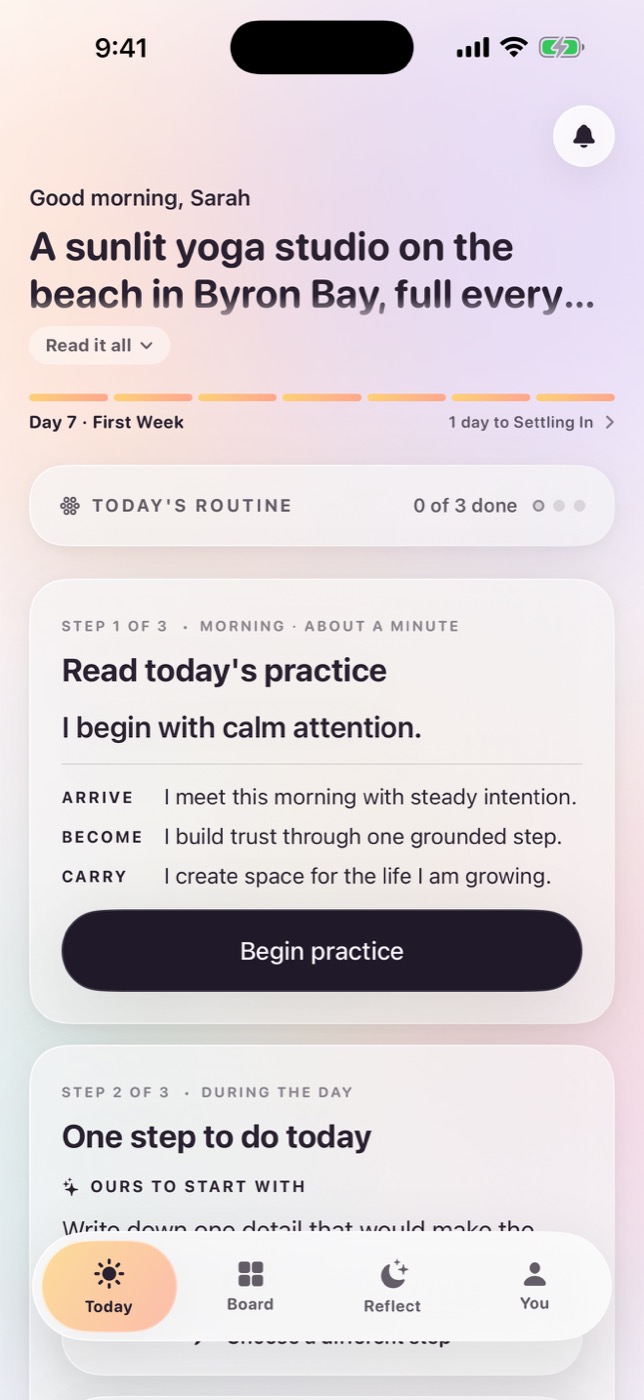
The short answer
Not in the sense of thought attracting outcomes, which no credible evidence supports. What is supported is narrower and still useful. Specific goals, implementation intentions, mental contrasting and consistent reflection improve follow-through, and an app that is built on those can genuinely help.
The question contains four different claims
"Do manifestation apps work" is usually asked as one question and it is really four. They have different answers, and separating them is the entire difference between a practice that helps and one that quietly costs you.
| The claim | Status |
|---|---|
| Thinking about an outcome causes it to happen | Not supported. No credible evidence. |
| A visual or written cue helps you notice and remember what matters | Plausible and context dependent. |
| Specific goals, plans tied to situations, and clear review improve follow-through | Reasonably well supported. |
| Dwelling on a desired outcome can reduce the effort you put in | Documented, and the part almost nobody mentions. |
Most apps in this category sell the first claim and deliver, at best, the second. The ones worth paying for are built on the third and are clear about the fourth. The rest of this page goes through each in turn.
What is not supported
The core law-of-attraction claim is that focusing on a desired outcome causes external reality to deliver it. There is no credible evidence for this, and it is not the sort of claim that is waiting on better studies. It proposes a mechanism by which private mental states influence unrelated events in the world, and nothing in the research literature supports that.
Research on manifestation belief has looked at who holds it and what it correlates with rather than whether it works. One line of work found that people who endorse manifestation beliefs tend to perceive themselves as more successful and to be more susceptible to certain financial risks, including bankruptcy and speculative investments. That is a finding about the believers, not a validation of the belief, and it points at the practical cost rather than at a benefit.
We say this plainly because the alternative causes harm. If you believe the outcome follows from the quality of your belief, then a setback is evidence that you did not believe correctly. That framing converts an ordinary bad quarter into a personal failing, and it discourages exactly the response that would have helped, which is changing something about what you are doing.
What is plausible but depends on the situation
A vision board makes an abstract goal concrete. That does something real and modest. Something you see daily stays available in memory, and when a relevant opportunity appears, whether a conversation, a listing or an invitation, you are more likely to recognise it as relevant.
This is ordinary cognition rather than anything mysterious, and it is genuinely useful. It is also easy to overstate. Noticing an opportunity is not the same as acting on one, and a board that improves your noticing while changing nothing about your week will produce a pleasant sense of alignment and no other result.
The other plausible effect is emotional. Imagery produces a motivational pull that a written objective often does not, which is why people build boards in the first place. That pull is fuel, and it is also the part that can work against you, which is the subject of the fourth claim below.
What is reasonably well supported
Here is the part that makes an app in this category worth using, and it has nothing to do with attraction.
Specific goals beat vague ones
Decades of goal-setting research find that specific and appropriately difficult goals are associated with better performance than vague encouragement to do your best. "Get healthier" is not a goal in this sense. "Run the same route three mornings a week" is. An app that forces you to state a direction concretely is doing something useful before it generates a single sentence.
Implementation intentions improve follow-through
A plan in the form "when situation X arises, I will perform response Y" has unusually consistent support across a wide range of behaviours. The mechanism is mundane. It delegates the decision to a cue, so you are not renegotiating with yourself at the moment of action, which is where most intentions die. An app that asks for a step with a trigger is applying this. An app that asks how you feel about your goal is not.
Mental contrasting beats fantasy alone
Pairing a vivid picture of the desired future with a clear look at the present obstacle, and then attaching a plan to that obstacle, is associated with better follow-through than dwelling on the outcome by itself. This is the single most important correction to conventional vision-board advice, and almost no app in the category implements it.
Reflection turns activity into information
Without a review step you repeat the same intention at the same size regardless of whether it is working, and you have no way to distinguish "this is hard" from "this is wrong". A short, clear-eyed review is what makes any of the above adaptive rather than merely repeated.
The documented downside
This is the finding the category does not mention. Research on positive fantasies has repeatedly found that indulging in a vividly imagined desired future can lower energy and predict poorer performance, apparently because the mind experiences part of the reward in advance.
Read that carefully, because it is easy to overclaim in the other direction. It does not mean visualization is useless, and it does not mean picturing your goals is harmful in general. It means that an outcome fantasy on its own, unpaired with the obstacle and unattached to a plan, is not neutral. It can substitute for the work rather than motivating it.
Which means an app built purely as an inspiration delivery mechanism, sending you a beautiful line about the life you want each morning and asking nothing of you, may be doing worse than nothing. That is an uncomfortable thing for us to write, since it describes a large part of our own category and a version of our own product that we were tempted to build.
The antidote in the same research is contrast and a plan. Picture the future, name the obstacle accurately, attach one action to the obstacle. Turning a vision board into daily action is the practical version.
What this means for an app specifically
An app can help with the supported parts more reliably than a notebook can, for three reasons that are about software rather than about psychology.
- Delivery. A widget or a watch complication puts your intention in front of you at the moment a decision is happening, which is when it changes behaviour. A notebook in a drawer cannot compete with that.
- Reduced friction. A one-tap reflection gets recorded on the evenings when writing a paragraph would not. The lowest-effort version of a practice is the one that survives.
- Memory. Software can read six weeks of your entries back to you and surface the pattern. Your memory over-weights the last two days and will not.
And an app can make things worse in ways a notebook cannot, mostly through incentives. An app funded by attention has a reason to keep you opening it rather than to keep you acting. Streak counters convert a practice into a score you can fail. Notification design optimised for return visits produces guilt, and guilt produces avoidance of the app holding your goals, which takes the goals with it.
Why the unsupported version is so appealing
It is worth understanding why the strong claim spreads, because the answer tells you something about what a good practice has to replace.
The first reason is that it offers control in situations where you have very little. Job markets, illness, housing and other people's decisions are largely outside your influence, and a belief that says your inner state is the lever is enormously comforting when the actual levers are out of reach. That comfort is real and it is not stupid to want it.
The second is survivorship. The people telling you it worked are, by definition, the ones for whom things worked out. Nobody writes the book about the two years of visualization that preceded no change at all, so the visible evidence is filtered before you ever see it.
The third is that the practice genuinely does something, just not the advertised thing. Someone who spends a month picturing a new career often does start noticing job listings, mentioning it to friends, and rewriting a CV. Those actions produce results, and the causal story available to explain them is the one they were given.
A grounded practice has to supply what the strong version supplied. Not the promise of control over outcomes, but a genuine sense of agency over the next step, and a record that shows movement when your memory says there has been none. That is what an evidence log is doing. See how to track evidence without forcing positivity.
Who this helps most, and who it does not
The research on the supported mechanisms points at a fairly specific profile, and it is not everybody.
| Situation | Likely to help? | Why |
|---|---|---|
| You know roughly what you want but keep not acting | Yes | This is precisely the gap implementation intentions close |
| Your goal is clear and the obstacle is time or friction | Yes | Contrast plus a smaller step is the documented fix |
| You act constantly but on the wrong things | Yes, via the reflection half | A written record makes the misdirection visible |
| You have no idea what you want yet | Partly | Getting specific helps, but exploration matters more than a daily loop right now |
| The obstacle is money, health or someone else's decision | Not much | No daily practice moves a constraint outside your control |
| You are in genuine distress | No | This is a moment for a qualified person, not a better prompt |
That last row matters more than the rest of the page. A daily practice built around noticing and acting is a poor fit when the difficulty is clinical, and an app that generates encouraging sentences is not equipped to be anything more than that. If reflection consistently leaves you feeling worse, or you cannot skip a day without anxiety, that is a signal to talk to someone rather than to find a better app.
How to tell whether an app is built on the supported part
You can assess this during a trial, in about twenty minutes, without knowing anything about the research.
- Does it make you state a specific direction? Or does it accept a category like "abundance" and generate from that? A category produces generic output forever.
- Does it ever ask for an action? If the entire product is content delivered to you, it is working on the plausible-but-weak claim at best.
- Does the action have a trigger? "Work on your goal" is a wish. "When X happens, I will do Y" is the supported form.
- Does it ask about obstacles? Mental contrasting requires the app to want to hear what is in the way, which most do not.
- Does it capture what actually happened? And can you read it back later in one place?
- Does anything change as a result? If week four looks identical to week one, nothing is adapting.
- Does it ever say it does not know? An app that always has an encouraging answer is not tracking reality.
Four or more yes answers puts an app on the supported side of the line. Our own framework for comparing products, including the disclosure that we make one of them, is at how to choose a manifestation app.
What to expect if you use one properly
Realistic expectations are the last piece, because most disappointment in this category comes from a promise that was never reasonable.
A well-built practice will make you notice your direction more often, take more small actions than you otherwise would, and have a written record that lets you see what is actually happening rather than what you feel is happening. Over months, that changes the number of useful decisions you make, and the compounding effect of that is real.
It will not compress the time a qualification takes, produce someone else's agreement, or change a market. It will not make a badly chosen goal work. And it cannot substitute for skill, resources, support or luck, all of which do more of the work in most outcomes than any daily practice does.
If that sounds like a smaller promise than the category usually makes, it is. It is also the one we can keep, and it is what MyDirection is built on.
Common questions
Do manifestation apps actually work?
Not by causing external events, which no credible evidence supports. They can help through goal specificity, implementation intentions, mental contrasting and consistent reflection, all of which are reasonably well supported and all of which require the app to ask something of you.
Is there any science behind manifestation?
There is good research on the mechanisms underneath a well-built practice, meaning goal setting, implementation intentions and mental contrasting. There is no scientific support for thought influencing external events, and research on manifestation belief itself has largely examined its correlates rather than validating it.
Can visualization be harmful?
Dwelling on an imagined outcome without pairing it to the present obstacle and a plan has been found to lower energy and predict poorer performance. Visualization paired with contrast and a specific action does not carry that problem.
Why do manifestation apps feel like they work at first?
Because getting specific about a goal genuinely helps, and because a new practice supplies novelty and a sense of momentum. The test is week six, when novelty is gone and only the structure remains.
What should I look for in an app?
One that makes you state a specific direction, asks for an action with a trigger, wants to hear about obstacles, records what actually happened, and changes based on it. Content delivered at you is the weak version.
Does MyDirection claim manifestation works?
No. We claim that specific goals, implementation intentions, mental contrasting, consistent small action and candid reflection help people follow through. That is a narrower claim and it is the one the product is built on.
Sources and further reading
- Locke & Latham: Building a practically useful theory of goal setting and task motivation
- Gollwitzer & Sheeran: Implementation intentions and goal achievement
- Oettingen: Future thought and behaviour change
- Kappes & Oettingen: Positive fantasies about idealized futures sap energy
- Dixon et al.: The psychology of belief in manifestation
For iPhone and Apple Watch
Keep your vision close.
Become it daily.
Start with a 3-day free trial and the complete app. $7.99 per week, $19.99 per month or $59.99 per year.
See pricing and trial